OpenPERouter #
OpenPERouter is an open implementation of a Provider Edge (PE) router, designed to terminate multiple VPN protocols on Kubernetes nodes and expose a BGP interface to the host network.
Enable VPN tunnels in your cluster #
OpenPERouter supports L3 and L2 overlays, and it integrates exactly like an external router.
L3 Overlays #
OpenPERouter can extend L3 VPN tunnels to any BGP enabled Kubernetes component, such as Calico, MetalLB, KubeVip, Cilium, FRR-K8s and many others, behaving as an external router.
L2 Overlays #
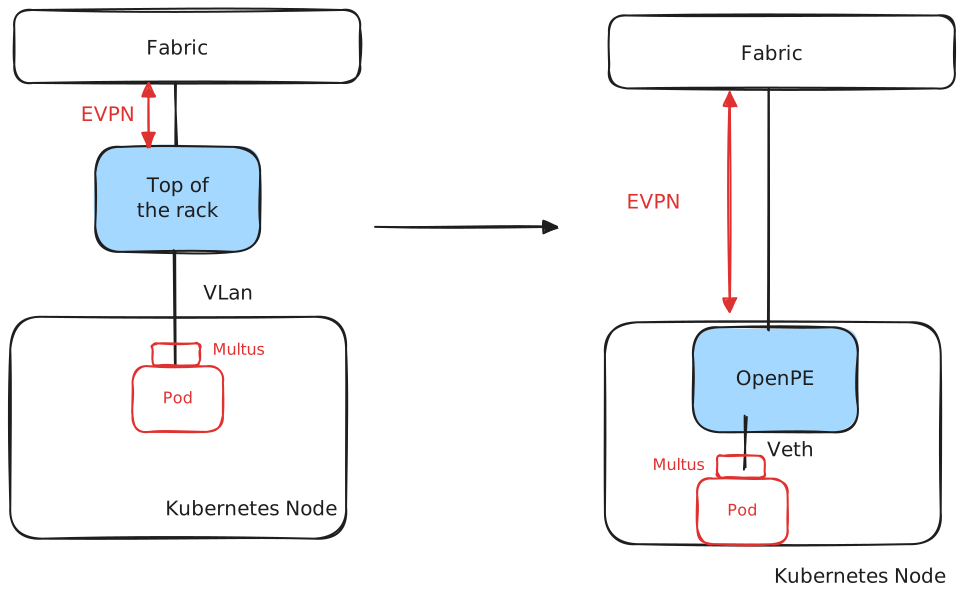
OpenPERouter supports L2 overlays too, allowing seamless communication between nodes using a stretched layer 2 domain. L2 Overlays can be used directly for nodes or they can integrate with Multus for pod secondary networks.
Additionally, L2 overlays can be mapped to a L3 routing domain for more complex scenarios.
Overview #
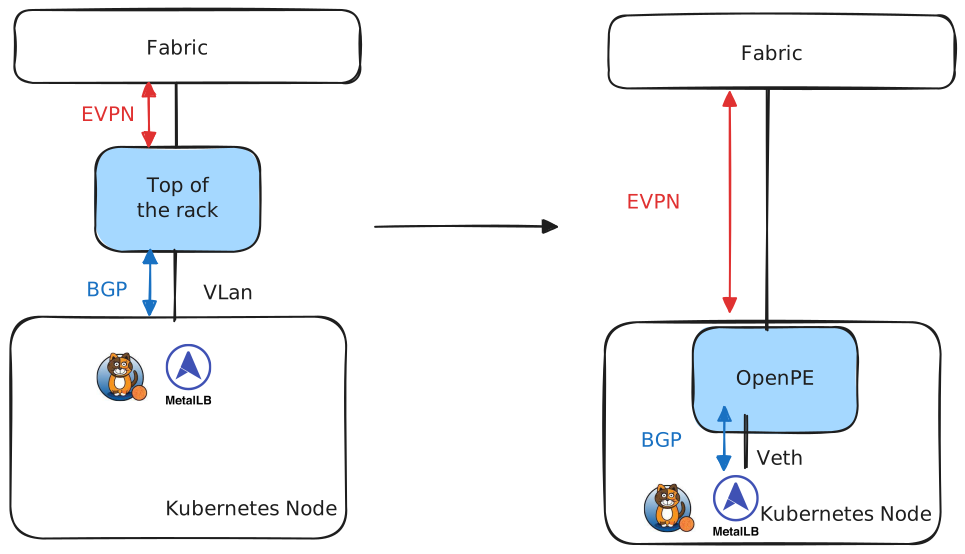
Where we normally have a node interacting with the TOR switch, which is configured to map the vlans to a given VPN tunnel, OpenPERouter runs directly in the node, exposing one Veth interface per VPN tunnel.
After OpenPERouter is configured and deployed on a cluster, it can interact with any BGP-speaking component of the cluster, including FRR-K8s, MetalLB, Calico and others. The abstraction is as if a physical Provider Edge Router was moved inside the node.
Here is a high level overview of the abstraction: on the left side, a classic Kubernetes deployment connected via vlan interfaces; on the right side, a deployment of OpenPERouter on a Kubernetes node:
L3:
L2:
Why Run the Router on the Host? #
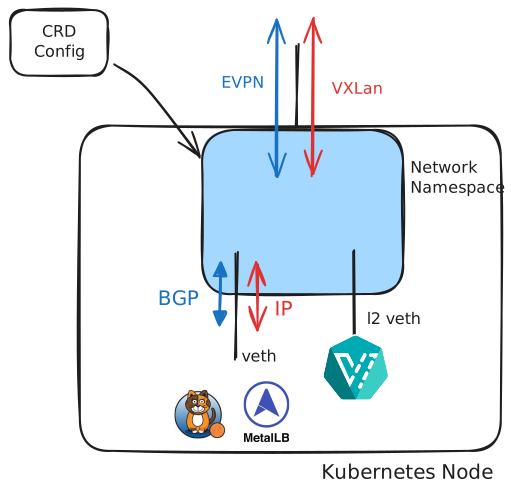
Running the router directly on the host provides greater flexibility and simplifies configuration compared to manually setting up each VPN tunnel and mapping it to a VLAN on a traditional router. With OpenPERouter, the configuration is managed using Kubernetes Custom Resource Definitions (CRDs), allowing you to declaratively define VPN tunnels and their properties.
A separate network namespace #
The router runs in a separate network namespace, and interacts with the host using a veth pair serving as entry points for the overlays. This allows it to be seen as a completely external component from a networking point of view, making it independent and integrable with the CNI running on the cluster.
Integration Benefits #
A key operational advantage is that no changes are required to your existing external router or network fabric. You can deploy the solution without reconfiguring your current network infrastructure.
OpenPERouter is a pluggable, CNI independent component that can run with your CNI of choice.
Seamless BGP Integration #
OpenPERouter behaves exactly like a physical PE router, enabling seamless integration with MetalLB, Calico, Cilium, FRR-K8s and any other BGP speaking component.
L2 integration with Multus #
With L2 overlays, the same configuration achievable with Vlans and Multus secondary interfaces can be achieved using OpenPERouter.